
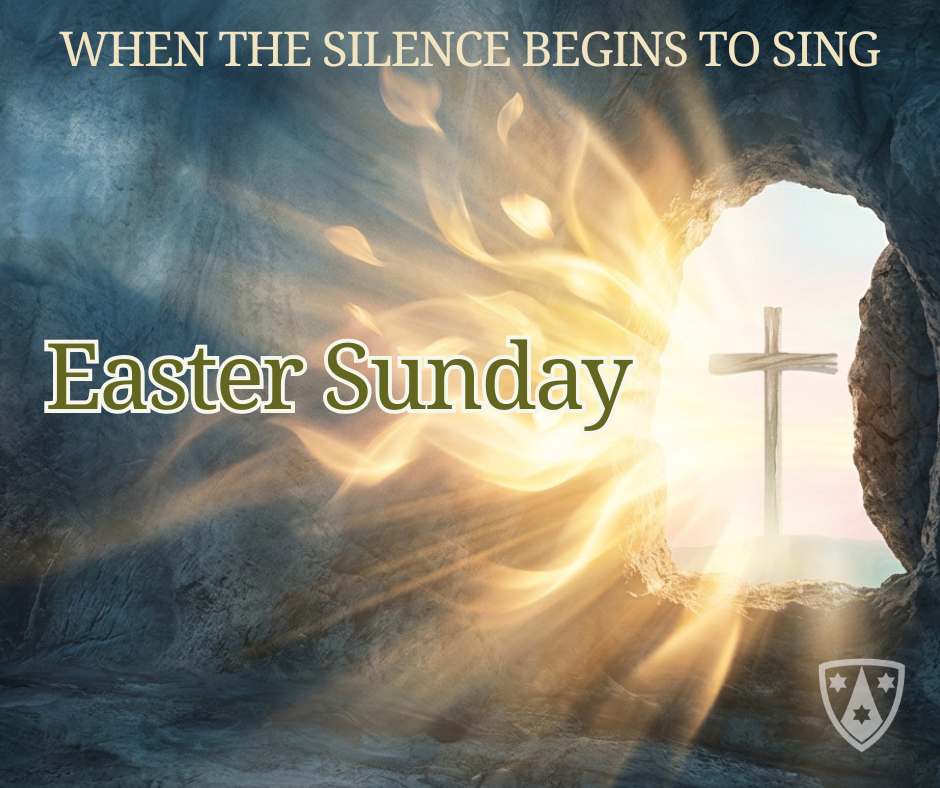
Most people hurry past Holy Saturday. It is the quietest day of the Church’s year, and perhaps for that reason the easiest to ignore. But no one escapes the reality it represents. Holy Saturday is the day in between—the space after something precious has died, but before anything new has begun. It is the long pause between loss and renewal; between the world we knew and the world we do not yet recognise. It is the day when life feels suspended, when we are neither here nor there, when the map has been taken from our hands and the road ahead is hidden.
And if we are honest, Holy Saturday is not a single day on a calendar. It is a season of the soul. It can last weeks, months, even years. Anyone who has buried a loved one knows that you do not move from Good Friday to Easter Sunday in twenty‑four hours. Anyone who has watched a relationship unravel, or seen a dream collapse, or felt the slow erosion of confidence, knows that Holy Saturday lingers. It is the place where we sit with what has been lost and cannot yet imagine what might be found.
That is where Mary Magdalene and the other Mary are in the Gospel. They are not doing anything heroic. They are not planning, fixing, or solving. They are simply sitting opposite the tomb. They saw Jesus die. They saw his body wrapped and laid to rest. They saw the stone rolled across the entrance. And now they sit in silence, facing the place where everything they hoped for seems to have ended.
There is a strange kind of faithfulness in that. Holy Saturday faith is not the faith of triumph or clarity. It is the faith of staying put. Of refusing to walk away from the place that hurts. Of trusting that even in the silence, God is not absent. It is the faith that waits without knowing what it is waiting for.
And where is Christ on Holy Saturday? The Creed tells us: He descended to the dead. He goes into the very depths—into the hells we carry, the griefs we hide, the fears we dare not name. Holy Saturday is the day Christ enters the locked rooms of our hearts and breaks the chains from the inside. It is the day he goes where we cannot go, to do what we cannot do.
And then—when the night has done its worst—something begins to stir.
The Gospel says that at dawn on the first day of the week, the earth shook. A new creation trembled into being. The women who had sat in silence now walk toward the tomb expecting only death, only the familiar weight of sorrow. But instead they find the stone rolled back, the guards scattered, and an angel sitting calmly on the stone as if to say, You thought this was the end? Watch closely.
“Do not be afraid,” the angel tells them. “He is not here; for he has been raised.”
It is the same story we hear every year. Some of you have heard it a handful of times; others have heard it more than seventy. The story never changes. But we do. And that is why we return to it. Not to learn something new, but to remember something true: that God has the first word, the last word, and every word in between. That death does not get the final say. That the tomb is not a destination but a doorway.
We often treat resurrection as something that happens after we die, a kind of divine insurance policy for the end of life. But the Gospel insists on something far more daring: resurrection is about now. It is about whether there is life before death. It is about the possibility that even in the middle of our Holy Saturdays—our uncertainties, our losses, our fears—God is already at work, already rolling stones away, already calling us into a future we cannot yet see.
Easter is not a promise that we will avoid suffering. It is the promise that suffering will not define us. It is not the denial of death. It is the transformation of death. The tomb becomes a womb. The place of ending becomes the place of rebirth. The silence begins to sing.
And that is the heart of the Easter message for us today.
Whatever Holy Saturday you are living through—whatever feels unfinished, unresolved, or unclear—Easter whispers that this is not the whole story. You may not yet see the path ahead. You may not yet feel the joy you long for. You may still be sitting opposite a tomb. But Christ is already on the move. He is already descending into the depths of your life, already breaking open the places that feel sealed shut.
The angel’s words to the women are spoken to us as well: “Do not be afraid.” Not because everything is easy, but because everything is held. Not because we know the future, but because God is already in it. Not because we are strong, but because love is stronger.
The real question of Easter is not whether the tomb was empty. It is what we will do with that truth. How will we live tomorrow, and the day after, and the day after that? Will we walk back into our lives as if nothing has changed? Or will we dare to believe that new life is possible for us—not someday, but now?
Easter invites us to live differently. To live as people who are no longer prisoners of fear. To live as people who trust that God is at work even in the silence. To live as people who know that every ending carries within it the seed of a beginning.
Christ is risen. So, live the resurrection. Live with courage. Live with generosity. Live with hope that refuses to be extinguished. Live with the quiet confidence that whatever comes, you will not face it alone.
The angel says, “Go quickly.” Not because there is something to escape, but because there is something to embrace. Life is calling. Love is calling. Christ is calling.
Run toward your future. Run toward the dawn. Run toward the God who has already run toward you.
Christ is risen. And because he lives, your story is not finished. New life is already unfolding. Even now. Even here.
Paul Jenkins O.Carm

