
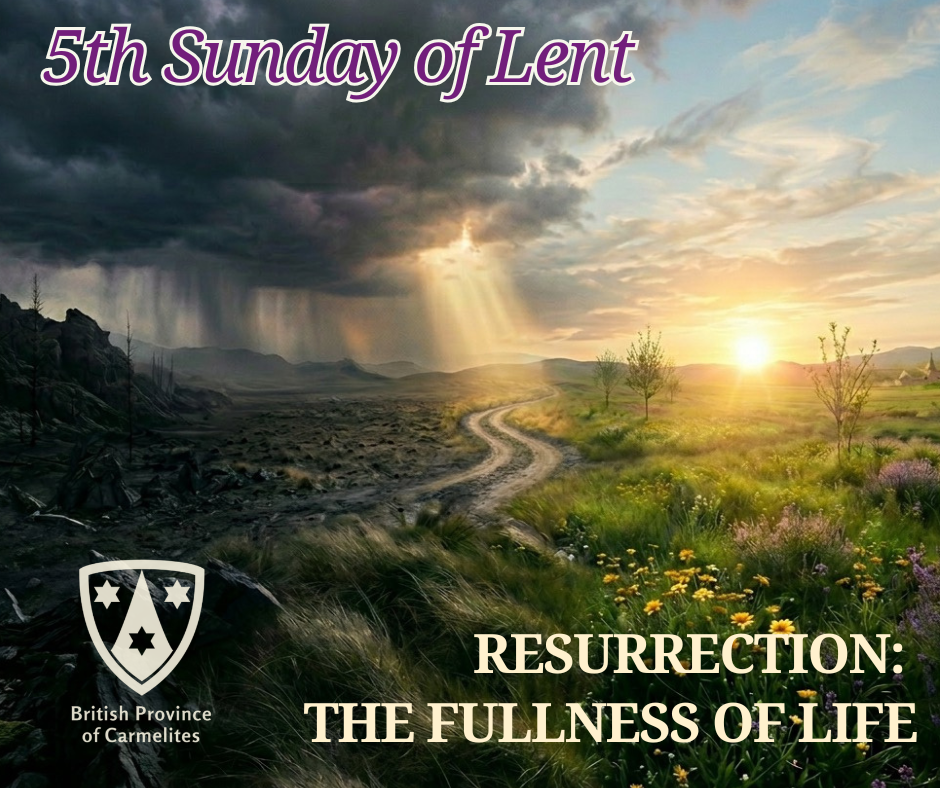
The readings for this Sunday draw us into one of Scripture’s most daring claims: God refuses to leave anything dead. Not bones scattered in a desert, not a friend sealed in a tomb, not the parts of our own lives that feel beyond repair. The God who speaks through Ezekiel and acts through Jesus is a God who breathes, summons, unbinds, and restores. That changes how we understand not only physical death, but every small death that touches our days.
Ezekiel is led by God into a valley filled with dry bones—an image of utter finality. These bones are not freshly dead; they are long-settled, sun‑bleached, beyond hope. Yet into that desolation God speaks a promise: “I will put my breath in them, bring them back to life, and let them live in their own land.”This is not optimism or a pep talk. It is God declaring that no ending is beyond his reach. The breath God gives is not simply animation; it is identity, dignity, belonging. “Let them live in their own land” means: I will restore them to themselves. I will give them back what fear, exile, and despair have stolen.
Most of us know what it is to stand in our own valley of bones. A relationship that has withered. A dream that quietly died. A part of ourselves we no longer recognise. A faith that feels thin and brittle. Ezekiel’s vision is not fantasy. It is a map of how God works: God begins where we think everything is over.
The Gospel takes us to another place of finality: the tomb of Lazarus. By the time Jesus arrives in Bethany, Lazarus has been dead four days. The stone is sealed. The mourners have come and gone. Martha and Mary are exhausted by grief and disappointment. Into that heaviness Jesus speaks a sentence that shifts the ground beneath them: “Your brother will rise again.” Martha answers with the faith she has: “I know he will rise on the last day.” It is a future hope, a distant promise—something to cling to, but not something that touches the pain she feels in the present moment.
Jesus refuses to leave resurrection in the future tense. “I am the resurrection and the life.” Not I will be, but I am. Not one day, but now. This is the turning point. Jesus is not simply promising that Lazarus will live again; he is revealing that resurrection is already breaking into the world wherever he is present. The raising of Lazarus is not a spectacle. It is a sign that the life of God is stronger than the forces that bind us, bury us, or convince us that nothing can change.
Before Jesus calls Lazarus from the tomb, he does something profoundly human: he weeps. He stands in the rawness of grief with Mary and Martha. He does not rush to fix, explain, or minimise their pain. He honours it. This is the God Christians believe in—not distant from suffering but moved by it; not untouched by death, but standing inside its shadow with us. And then he speaks the words that echo through every century of Christian faith: “Lazarus, come out!”
The dead man emerges—still wrapped, still bound, still carrying the signs of what he has been through. Jesus then turns to the community and says: “Unbind him and let him go free.” This is resurrection in real time. God calls us out of whatever tomb we’ve settled into, and God asks the community of believers to help unbind what still clings to us.
Most of us will never face a stone‑sealed cave, but we know the experience of being trapped. Some tombs are obvious: grief, addiction, fear, shame. Others are quieter: cynicism, resentment, self‑doubt, the slow erosion of hope. Sometimes we bury ourselves. Sometimes life buries us. Sometimes others do. But the voice of Jesus is the same: Come out. Come out of the story that says nothing can change. Come out of the bitterness that has become a second skin. Come out of the fear that keeps you small. Come out of the guilt that convinces you you’re unworthy of joy. Come out of the exhaustion that whispers that God has forgotten you.
Resurrection is not only about what happens after death. It is about what God is doing now—in the middle of our unfinished stories, our tangled relationships, our fragile faith. And just as Lazarus needed others to help remove his burial cloths, so too do we. Jesus could have unwrapped Lazarus himself, but he gives that task to the community. Resurrection is God’s work; unbinding is ours. Every day we meet people who are still wrapped in something that restricts their movement toward life: a teenager carrying shame, a parent overwhelmed by failure, a neighbour trapped in loneliness, a friend who cannot forgive themselves. To follow Jesus is to hear him say to us: Help them. Unbind them. Let them go free. We do this through compassion, truthfulness, patience, forgiveness, and the kind of presence that tells another person: You are not alone in this tomb. And we allow others to do the same for us.
This gospel comes just before Holy Week for a reason. It prepares us to understand what is coming. The raising of Lazarus is the sign; the resurrection of Jesus is the reality. But the pattern is the same: God enters what is dead. God breathes. God calls. God restores. And God does this not only once, but continually, in every life that dares to trust that love is stronger than death.
The question Jesus asks Martha is the question he asks us: “Do you believe this?” Not as an exam question, but as an invitation. Do you believe that God can breathe life into what feels finished? Do you believe that resurrection is not only a future hope but a present possibility? Do you believe that nothing—absolutely nothing—is beyond the reach of God’s love?
As we move toward Holy Week, that is the faith we are asked to carry: a faith that listens for the voice calling us out of our tombs, and a faith that helps us unbind others so they can walk into the light.
Paul Jenkins O.Carm

