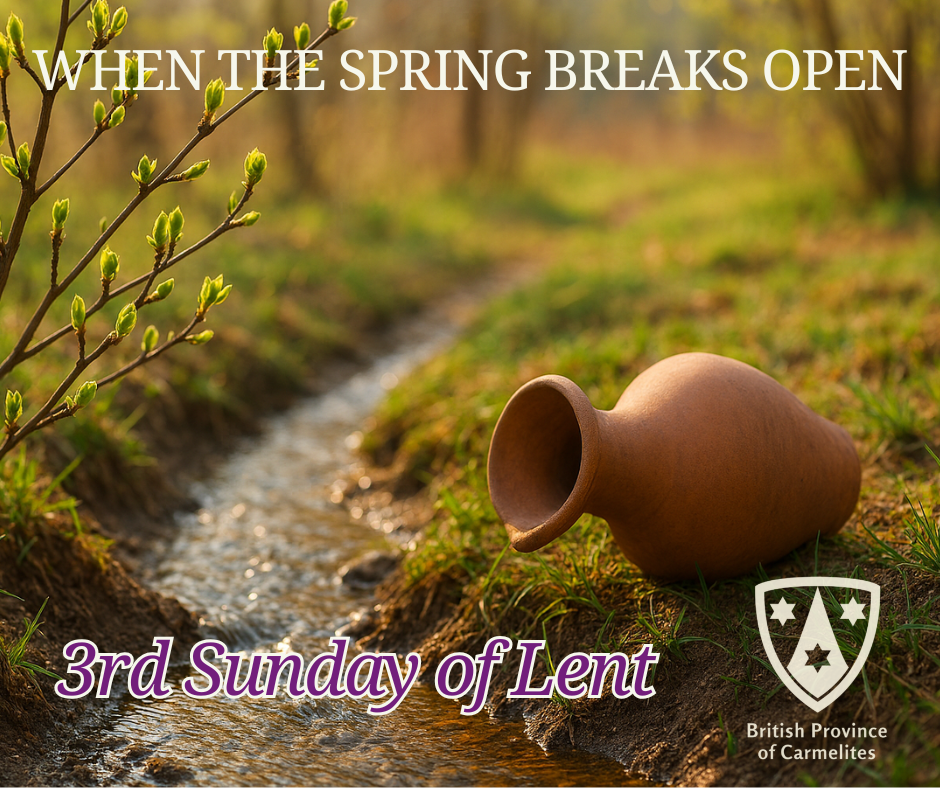
He arrives at the well at the wrong time of day—heat pressing down, dust rising, the kind of hour when even the shadows seem to retreat. Jesus sits there, tired and thirsty, resting beside a well that has heard and witnessed the stories of generations. Nothing dramatic. Nothing holy-looking. Just a weary man beside ancient stone. And then she arrives. Not drifting, not floating, but moving with the quiet caution of someone who has learned to expect very little from life. Her steps are measured. She has chosen noon precisely because it promises emptiness—no neighbours, no sidelong glances, no whispered reminders of the life she has lived and the life she has lost.
Jesus is there—unexpected, uninvited, unembarrassed by the awkwardness of the moment. He asks for a drink. A small request, but it unsettles her. It is as though he has crossed a boundary she thought was permanent. She pushes back, half defensive, half intrigued. Why would he speak to her? Why would he need anything from her?
Jesus begins to speak to her of living water—of a spring rising from within rather than a bucket lowered from without. She hears the words, but more than that, she feels something loosen inside her. A softening. A quiet sense that the long drought she has lived with might not be the final truth about her.
She tests this feeling, and Jesus meets her there. He speaks her story aloud with a tenderness that does not wound. He brings her truth into the open not to expose her, but to lift the weight she has carried alone for so long. There is no accusation in his voice—only the quiet assurance that she no longer needs to hide. He treats her as someone who can bear honesty, someone whose heart is wide enough for revelation, someone who is more than the fragments of her past. In naming her story, he opens a doorway through it—inviting her into a life she has not yet imagined.
And then he says it simply, without drama: “I am he.”
The hope she mentioned only in passing—half believing, half protecting herself—is suddenly standing before her. The One she never thought would notice her is speaking to her as though she has always mattered. In that moment, everything narrows to the space between them. No crowds. No noise. No history. Just the Messiah offering himself to her without hesitation. He trusts her with who he is. He lets her be the first to hear what others have struggled to understand.
And something inside her responds. The promise of living water stops being an idea and becomes a movement—quiet at first, then unmistakable. It rises like a fresh current breaking through dry ground. Recognition. Relief. Awakening.
She cannot keep it to herself. She leaves her water jar behind—the symbol of the old life, the old thirst, the old rhythm of survival. She runs back to the very people she had been avoiding. The ones who judged her. The ones who kept her at a distance. But she is not the same woman who walked to the well.
“Come and see the man who told me everything I have ever done,” she says. And they follow her. They listen. They come to Jesus because something in her has become unmistakably alive. She becomes a witness without trying to be one—born again into a new courage, a new clarity, a new joy.
This is how grace moves: quietly, personally, insistently. Jesus meets one woman at a well, and from that single encounter an entire village is drawn into his presence. The disciples, still trying to understand, watch as the boundaries they thought were rigid begin to soften and fall away.
The living water is never rationed. It does not trickle cautiously. It spills over. It seeks the low places. It moves toward those who feel overlooked, those who have been pushed aside, those who come to the well at noon because they have run out of safer hours. It finds them gently, and once it begins to flow, it keeps going.
During Lent we stand with this woman. Each of us comes to Jesus carrying our own mixture of thirst and weariness, our own tangled histories, our own quiet hope that maybe—just maybe—God might meet us. And he does. He sits beside the well of our life. He asks for a drink. He begins a conversation that goes deeper than we expect. And somewhere in that exchange, the spring begins to rise.
Paul Jenkins O.Carm