
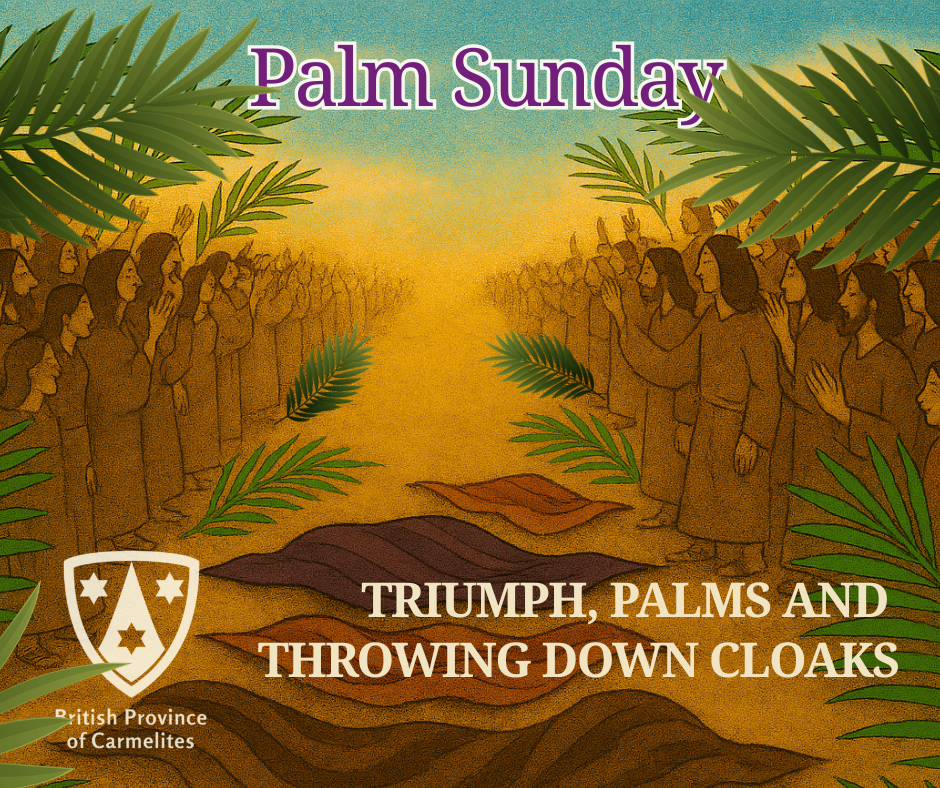
What exactly is the triumph in today’s gospel? We call it the triumphal entry, yet it hardly resembles the kind of triumph we instinctively imagine. There is no military parade, no display of power or prestige. Jesus simply rides a borrowed colt. His followers are not an army but a small, hopeful, slightly bewildered group of disciples singing psalms. There are no banners, no trumpets—only old cloaks thrown down on a dusty mountain path, the humble offerings of
Today we hear St. Matthew’s account, however in St Luke’s Gospel, at this very moment of ‘triumph’ we find Jesus weeping as he approaches the city. (Just pause with that for a moment). This is not the victory lap of a conquering hero. This is a man—Messiah, Beloved, Anointed Son of God descending a hill into a city that will misunderstand him, resist him, and ultimately kill him. It is a literal and figurative downhill journey, carrying the weight of every human sorrow.
In a few days’ time there will be no high fives, no chants of “We’re number one,” no victory speeches. Instead, we will encounter a quiet grief, a tenderness that aches, a love that sees the brokenness of the world and refuses to turn away. Because triumph, for Jesus, is not about winning. It is about fullness of life—life offered, life poured out, life shared. And here, on this hillside, the Mount of Olives, we begin to see that the real triumph of God often looks nothing like triumph to us. It looks like tears. It looks like vulnerability. It looks like a heart breaking open for the sake of others.
The triumphal entry does not begin with a colt on the Mount of Olives. It begins with a young woman in Nazareth whispering, “Let it be with me according to your word.” With those words “let it be” Mary opens herself, her womb, the world, and all of humanity to God. Her “let it be” is the quiet triumph that makes every other triumph possible. For her it is the triumph of trust over fear, openness over self‑protection, surrender over control. It is the triumph that teaches us what Jesus will later show us: that God’s glory is revealed not in strength but in self‑giving love.
The triumphal happens in every moment where God enters human life and we, like Mary, dare to say yes. The triumphal entry is Jesus bringing good news to the poor, healing the broken‑hearted, giving sight to the blind, releasing captives, lifting up the oppressed. It is Jesus including the outcast, setting a place for the unacceptable, forgiving sinners, loving enemies, raising the dead.
Everywhere he goes, he tramples the cloaks that hide the fullness of life. Everywhere he goes, he reveals new life, new hope, new possibility. And he does none of this through domination, control, or political manoeuvring. We may want a triumphant Jesus who will pluck us out of difficulty, who will fix everything from a safe distance. But that is not what he does. He offers himself—completely, vulnerably, without reserve. He enters the very places we avoid. He embraces the very suffering we fear. He reveals God’s presence not by escaping human pain but by inhabiting it.
Here we need to take a moment to understand the gesture of throwing down cloaks. In Jesus’ time, cloaks were not decorative extras; they were essential—protection, warmth, even a sign of one’s identity. To throw down a cloak was to offer something of yourself, something that covered you, something that kept you safe. It was a small act of surrender, a symbolic laying aside of one’s own defences.
If we truly desire Jesus to enter the deepest places of our lives, we first need to notice the ways we keep ourselves cloaked. Whenever we hide our vulnerabilities—our fears, our guilt, our regrets, our need for control—we quietly resist his triumphal entry. We all have cloaks we pull tightly around us: anger, perfectionism, sorrow, prejudice, pride, the hunger for approval. Most of us wear more than one. And every cloak, no matter how familiar or comforting it may seem, ends up distancing us from God, from others, and even from our own true selves.
The real triumph of Palm Sunday is not waving palms. It is throwing down our cloaks. It is standing before God without pretence, without armour, without excuses. It is allowing Jesus to walk into the tender, hidden, painful places of our lives.
Holy Week is not a pageant we watch. It is the long unfolding of Mary’s “let it be” in the life of every disciple. It is a path we walk. It is the slow, deliberate journey: from triumph to table, from table to garden, from garden to cross, from cross to tomb, from tomb to dawn.
This week invites us to walk with Jesus not as spectators but as companions.
To let him enter the places we keep closed. To let him wash the parts of us we would rather hide. To let him carry what we cannot. To let him love us where we feel unlovable.
So, the question of Palm Sunday is not whether we will wave palms. The question is whether we will throw down our cloaks. Whether we will allow the triumphal entry to happen in us. Because the triumph of this day is not Jesus entering Jerusalem. It is Jesus entering us.
Paul Jenkins O.Carm

